
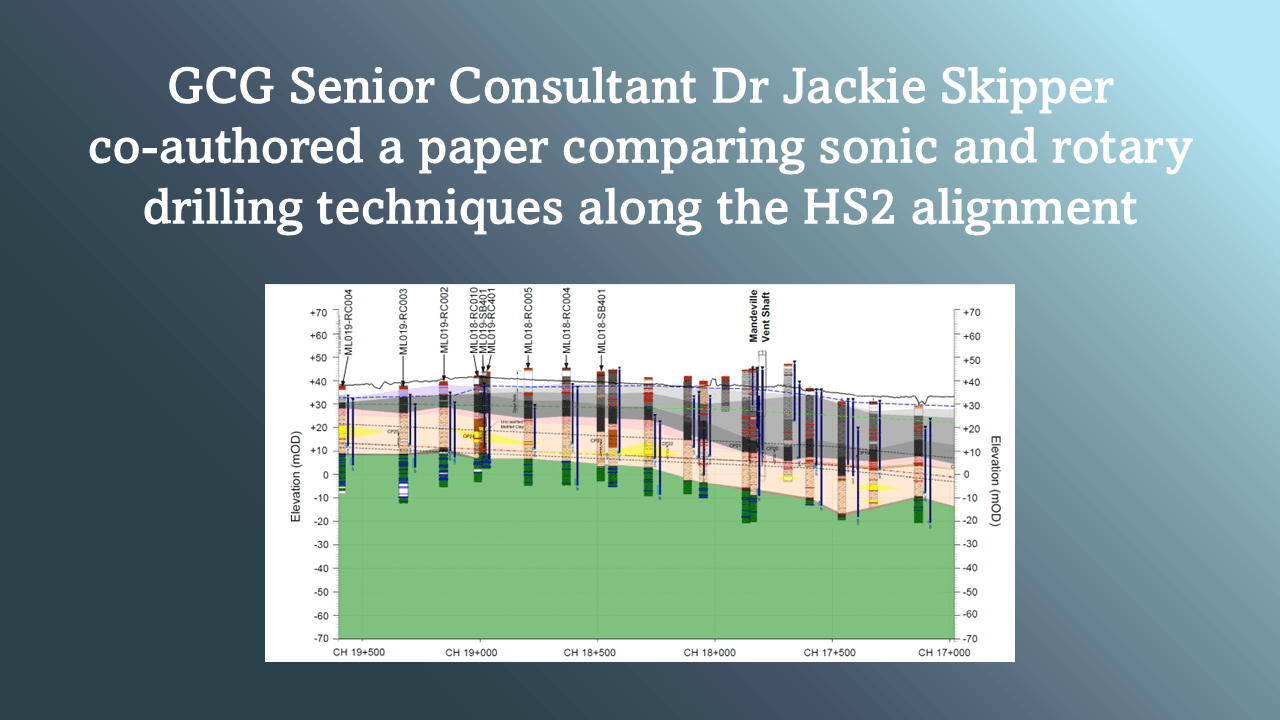
Geotechnical Consulting Group (GCG) is pleased to highlight a new technical paper examining the performance of sonic and rotary borehole drilling techniques in highly variable ground conditions along the High Speed 2 alignment in Northwest London.
The paper, “A comparison of rotary and sonic borehole drilling techniques in the Lambeth Group and Chalk Group on the HS2 alignment in Northwest London”, has been lead authored by Emily Prosser of Mott MacDonald, following research undertaken as part of her MSc at Imperial College London. The MSc research was supervised by GCG’s Dr Jackie Skipper and GCG Associate Dr James Lawrence of Imperial College London who are co-authors of the paper.
The research presents a valuable case study from the HS2 Ruislip to Northolt Tunnel section, where closely spaced sonic and rotary boreholes provided an opportunity to directly compare the performance of the two drilling techniques within the complex and highly variable Lambeth Group and Chalk Group.
Understanding a Critical Ground Risk
Within this section of the HS2 alignment, cross passages connecting the two main railway tunnels encountered sand channels within the Lambeth Group Reading Formation.
The potentially high permeability of these sands, combined with high groundwater levels, represented a significant construction risk and made a detailed understanding of the ground conditions particularly important.
Rotary boreholes undertaken in the area achieved very low recovery within some of the sand channels. HS2 therefore made the decision to undertake sonic drilling close to the existing rotary boreholes to obtain further information.
The sonic boreholes achieved significantly improved recovery of the sands and revealed highly variable, rapidly changing particle size distributions – characteristics consistent with deposition within meandering river channels.
The combined ground information provided important evidence for the assessment of risk associated with construction of the cross passages, and informed the decision by contractors SCS and the client HS2 to adopt ground freezing as the method of managing the challenging ground and groundwater conditions.
Selecting the Right Investigation Technique
Few published studies directly compare the performance of closely spaced sonic and rotary boreholes, making this case study a useful contribution to the industry’s understanding of ground investigation techniques.
Importantly, the research does not suggest that one drilling method is universally preferable to another. Each technique has its own advantages and limitations.
Instead, the paper demonstrates the importance of selecting drilling and investigation methods according to the specific geological conditions, the information required and the geotechnical objectives of the project.
The paper compares the two drilling techniques across a range of parameters, demonstrating how the choice of investigation method can influence the quality and completeness of the ground information available to designers, contractors and clients – and ultimately support better-informed management of geotechnical risk.
The paper is now published online in the Quarterly Journal of Engineering Geology and Hydrogeology.
Read the abstract and paper details via the Geological Society’s Lyell Collection:
https://www.lyellcollection.org/doi/abs/10.1144/qjegh2025-195